

Are Cantilever Outdoor Parasols More Stable Than Traditional Ones
2025-12-29
When designing your perfect outdoor living space, selecting the right shade solution is paramount. Two primary contenders dominate the market: the classic center-pole Outdoor Parasol and the modern cantilever (offset) design. A critical question for homeowners is stability. We at Norler, experts in premium outdoor furniture, delve into a professional comparison to determine if cantilever Outdoor Parasols truly offer superior stability.
The core difference lies in the support structure. A traditional parasol has a pole running through its center, anchoring it in the middle of a table or a base. A cantilever Outdoor Parasol features an offset pole and a horizontal arm, allowing the canopy to extend freely without a central obstruction.
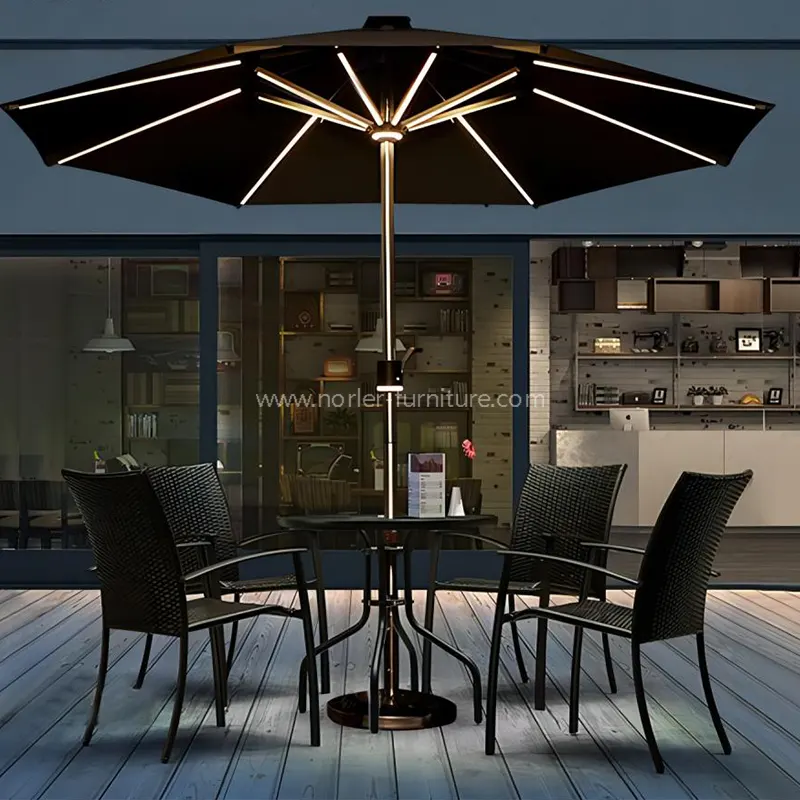
Key Factors Influencing Stability:
-
Wind Resistance: The cantilever design often has a lower, heavier base and a pivoting canopy that can tilt and rotate to shed wind, potentially offering better aerodynamic performance.
-
Base Weight: Stability for any parasol is dictated by an adequately weighted base. Cantilever models typically require heavier bases due to the leveraged weight of the offset canopy.
-
Footprint & Obstruction: The traditional central pole can be an obstacle, while the cantilever’s offset pole clears floor space.
The following table breaks down the stability attributes side-by-side:
| Feature | Cantilever Outdoor Parasol | Traditional Center-Pole Parasol |
|---|---|---|
| Center of Gravity | Lower and centralized over the base. | Higher, along the central pole. |
| Wind Response | Canopy can tilt/rotate to deflect wind; less sail-like. | Fixed position; more prone to catching wind like a sail. |
| Base Requirement | Requires a very heavy base to counterbalance the offset leverage. | Requires a heavy base, but generally less than an equivalent cantilever. |
| Lateral Stability | Excellent when properly weighted; less prone to tipping sideways. | Good with proper base; the pole can act as a pivot point in strong wind. |
Conclusion: A high-quality cantilever parasol from Norler, paired with its recommended weighted base, is generally more stable in varied conditions due to its intelligent design that manages wind force and leverages a low center of gravity. However, a traditional parasol with a sufficiently heavy base can also be very stable for sheltered areas.
Outdoor Parasol FAQ
Q: What is the best base for my Norler cantilever parasol?
A: Always use the manufacturer-recommended base. For Norler cantilever models, we advise a base weighing at least 50kg (110 lbs) to safely counterbalance the offset canopy and ensure maximum stability in breezy conditions.
Q: Can I leave my Outdoor Parasol outside all year round?
A: It is not recommended. Despite using durable materials, prolonged exposure to harsh weather (snow, ice, storms) can shorten its lifespan. We recommend storing your Norler parasol in a dry place during off-season months or using a protective cover.
Q: How do I clean my fabric canopy?
A: For Norler parasols with solution-dyed acrylic fabric, regular maintenance is simple. Use a soft brush or sponge with a mild soap solution (e.g., lukewarm water and dish soap) to gently clean. Always allow it to air dry completely before closing to prevent mildew.
Ready to experience the superior stability and sleek design of a Norler cantilever Outdoor Parasol? Contact us today for a personalized consultation to find the perfect shade solution for your garden, patio, or poolside.