

How Does a Powder-Coated Frame Resist Corrosion in Beach Trolleys?
2026-09-18
1. Why Does Standard Paint Fail So Quickly in a Beach Environment?
Standard liquid paint is applied in thin layers, typically 25 to 50 microns. It dries by solvent evaporation, which leaves microscopic pores in the film. In a beach environment, salt water and moisture penetrate these pores and reach the steel substrate. Once the moisture reaches the steel, corrosion begins. The corrosion products expand and lift the paint film, causing it to flake off. This process accelerates rapidly in the presence of chloride ions, which are abundant in sea spray. In our factory, we have tested standard painted frames in a salt spray chamber according to ASTM B117. The first signs of rust appeared within 120 hours. For a Beach Trolleys that is used daily on the sand, that translates to less than six months of service before visible corrosion.
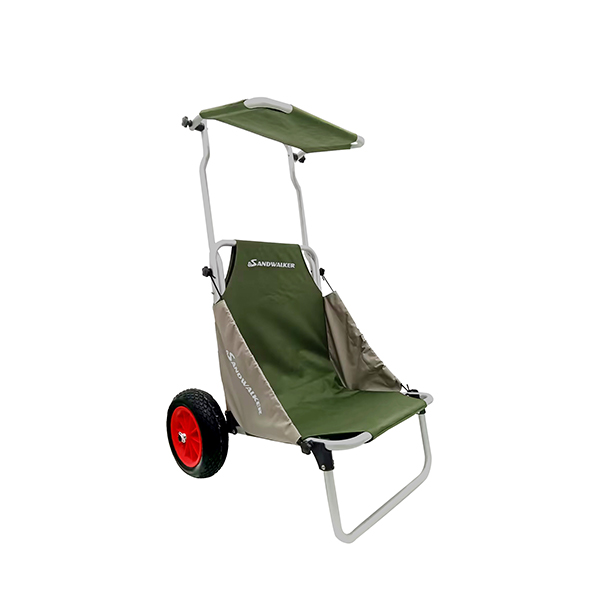
The table below compares the corrosion resistance of standard paint and powder coating.
| Coating type | Typical thickness (microns) | Salt spray resistance (ASTM B117) | Expected life in beach environment |
| Standard liquid paint | 25 – 50 | 120 – 240 hours | 6 – 12 months |
| Powder coating (standard) | 60 – 80 | 500 – 1,000 hours | 2 – 3 years |
| Powder coating (marine grade) | 100 – 150 | 2,000 – 3,000 hours | 5 – 8 years |
| Hot-dip galvanizing + powder | 150 – 200 | 3,000+ hours | 8 – 12 years |
Ningbo Marine Outdoor Products Co., Ltd. manufactures Beach Trolleys with marine-grade powder coating as the standard finish. Our factory uses a multi-stage pretreatment process that includes degreasing, phosphating, and sealing before the powder is applied. This ensures that the coating adheres to the steel and does not flake under impact.
2. How Does the Powder Coating Process Create a Corrosion Barrier?
Powder coating is fundamentally different from liquid paint. Instead of a solvent-borne liquid, it uses a dry powder that is electrostatically charged and sprayed onto the grounded metal surface. The charged particles adhere to the metal and are then cured in an oven at 180°C to 200°C. During curing, the powder melts and flows into a continuous, cross-linked film. This film has no pores and no solvent残留. It is a solid barrier that blocks the ingress of salt water and oxygen. The thickness of the film is also much greater than liquid paint—typically 60 to 150 microns, compared to 25 to 50 microns. The table below shows the key process steps and their role in corrosion resistance.
| Process step | Purpose | Typical parameters |
| Degreasing | Removes oil and grease from the steel surface | Alkaline cleaner at 55°C |
| Phosphating | Creates a conversion coating that improves adhesion | Zinc phosphate at 45°C |
| Sealing | Closes the phosphate layer and enhances corrosion resistance | Chrome-free seal at 30°C |
| Powder application | Applies the charged powder to the steel | Electrostatic spray at 60 kV |
| Curing | Melts and cross-links the powder into a continuous film | 190°C for 15 minutes |
The phosphating step is particularly important for Beach Trolleys because it creates a crystalline layer that bonds chemically to both the steel and the powder. Without phosphating, the powder coating can chip off under impact, exposing the bare steel to corrosion. Our factory performs a tape adhesion test on every batch to verify the bond strength.
3. What Coating Specifications Should Buyers Require for Beach Trolleys?
When sourcing Beach Trolleys for coastal use, buyers should require the following specifications. First, the coating thickness should be at least 100 microns for marine environments. Thinner coatings may be sufficient for inland use but will not last in salt spray. Second, the powder should be a polyester or polyester-epoxy hybrid formulated for outdoor exposure. These powders resist UV degradation, which prevents the coating from chalking or fading. Third, the pretreatment should include phosphating and sealing. Fourth, the coating should pass a salt spray test of at least 2,000 hours according to ASTM B117. Fifth, the coating should be free from visible defects such as runs, sags, or orange peel. The table below summarizes these specifications and their importance.
| Specification | Minimum requirement for beach use | Why it matters |
| Coating thickness | ≥ 100 microns | Thicker barrier for salt and moisture |
| Powder type | Polyester or polyester-epoxy | UV resistance, color stability |
| Pretreatment | Phosphating + sealing | Adhesion and corrosion resistance |
| Salt spray test | ≥ 2,000 hours (ASTM B117) | Verified performance in salt environment |
| Impact resistance | ≥ 50 kg·cm (ASTM D2794) | Resists chipping from sand and stones |
| Adhesion | Pass tape test (ASTM D3359) | Prevents flaking and peeling |
Ningbo Marine Outdoor Products Co., Ltd. manufactures Beach Trolleys that meet or exceed these specifications. Our factory uses a 120-micron marine-grade polyester powder and a five-stage pretreatment line. Every batch is tested for salt spray resistance and impact resistance before shipment.
4. How Should Beach Trolleys Be Maintained to Maximize Coating Life?
Even the best powder coating requires some maintenance to achieve its maximum service life in a beach environment. The three most important maintenance practices are rinsing, inspection, and touch-up. Rinsing the trolley with fresh water after each use removes the salt deposits that accumulate on the surface. If salt is left on the coating, it can attract moisture and eventually penetrate any minor defects. Inspection should be performed monthly. Look for chips, scratches, or areas where the coating has worn thin. Touch-up should be performed immediately if damage is found. Use a matching powder coating touch-up pen or a small amount of two-part epoxy paint. Do not use standard spray paint, which will not adhere to the powder coating and may trap moisture. In our factory, we provide a maintenance kit with every Beach Trolleys that includes touch-up paint and instructions.
Frequently Asked Questions About Powder-Coated Beach Trolleys
Summary for Beach Equipment Buyers
Powder coating is the most effective finish for Beach Trolleys in coastal environments. It provides a thick, continuous barrier that resists salt spray, moisture, and impact. The key specifications are coating thickness of at least 100 microns, a marine-grade polyester powder, phosphating pretreatment, and a salt spray resistance of at least 2,000 hours. With proper maintenance, including rinsing and touch-up, a powder-coated frame can last 5 to 8 years. Ningbo Marine Outdoor Products Co., Ltd. has been manufacturing Beach Trolleys for over 12 years and supplies to resorts and rental operators worldwide.
Ningbo Marine Outdoor Products Co., Ltd. manufactures Beach Trolleys with marine-grade powder coating, stainless steel hardware, and UV-resistant components. We provide full material specifications and test reports for all of our products.