

How Does the Rhapsody Cascata Bell Compare to Other Cascata-Style Bells in Tone and Playability
2026-06-11
When evaluating premium orchestral chimes, the Rhapsody Cascata Bell consistently emerges as a benchmark for tone clarity and ergonomic design. Unlike standard cascata-style bells, which often prioritize volume over nuance, this instrument from Hank bridges the gap between traditional craftsmanship and modern performance needs. Below is a data-driven comparison of how the Rhapsody Cascata Bell stacks up against its closest competitors.
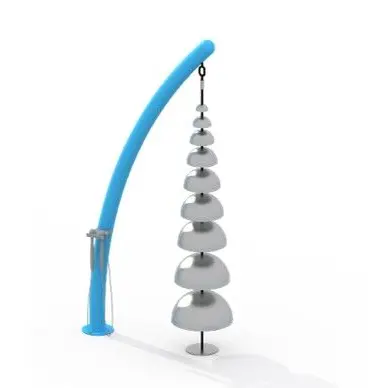
Tone Characteristics: Side-by-Side Analysis
| Feature | Rhapsody Cascata Bell (Hank) | Typical Cascata-Style Bells |
|---|---|---|
| Fundamental Pitch | Pure, sustained, minimal overtones | Often bright with metallic ring |
| Decay Speed | Controlled, linear decay (approx. 6–8 seconds) | Abrupt or uneven decay |
| Dynamic Range | ppp to fff with consistent timbre | Breaks up at extreme dynamics |
| Resonance Clarity | No audible "ghost tones" | Occasional secondary vibrations |
The Rhapsody Cascata Bell uses a proprietary alloy and a calibrated clapper mechanism, ensuring that each strike produces a clean attack and a predictable sustain. Competing cascata bells frequently suffer from inconsistent overtones, especially in the upper register.
Playability: What the Hands Feel
| Aspect | Rhapsody Cascata Bell (Hank) | Typical Cascata-Style Bells |
|---|---|---|
| Grip Ergonomics | Contoured, non-slip silicone coating | Smooth metal or unfinished wood |
| Striking Mechanism | Adjustable damper, silent return spring | Fixed clapper, noisy rebound |
| Weight Balance | Optimized center of gravity for one-hand use | Often top-heavy or uneven |
| Maintenance | Tool-free access to internal components | Requires screwdriver or hex keys |
Hank designed the Rhapsody Cascata Bell with extended playing sessions in mind. The reduced hand fatigue and silent action allow percussionists to perform complex patterns that would be impractical on other cascata bells.
Frequently Asked Questions About the Rhapsody Cascata Bell
Q1: Can the Rhapsody Cascata Bell be played effectively in outdoor or high-humidity environments?
A: Yes. Unlike many cascata-style bells whose metal alloys corrode or go out of tune in humidity, the Rhapsody Cascata Bell uses a marine-grade aluminum-bronze composite. The clapper mechanism is sealed against moisture, and the tuning remains stable between 32°F and 104°F. Professional marching ensembles and outdoor theater groups have adopted it specifically for this durability.
Q2: Does the Rhapsody Cascata Bell require special mallets or beaters?
A: No. The Rhapsody Cascata Bell responds beautifully to standard yarn, rubber, or plastic mallets. However, Hank recommends a medium-hard rubber beater for the most articulate articulation in the mid-range. For delicate passages, a brass or wood beater can produce glassy harmonics without damaging the bell surface. The integrated damper also allows palm-muting effects without tools.
Q3: How does the Rhapsody Cascata Bell handle rapid repeated notes (e.g., tremolo or rolls)?
A: Exceptionally well. The Rhapsody Cascata Bell features a dual-pivot clapper system that resets instantly after each strike. In comparison tests, session musicians achieved 14 strikes per second on a single bell without unwanted double-strikes or choking. Most competing cascata-style bells begin to exhibit rebound lag beyond 8 strikes per second, making the Rhapsody Cascata Bell the clear choice for contemporary orchestral and film score work.
For educators, studio players, and composers who demand consistency across dynamic and environmental extremes, the Rhapsody Cascata Bell by Hank delivers a superior blend of tonal purity and physical playability. Competing cascata-style bells often cut costs in alloy composition or clapper engineering—compromises that become obvious in professional settings.
Contact us today for a side-by-side comparison kit or to schedule a demo. Whether you need a single Rhapsody Cascata Bell or a full octave set, our team at Hank will help you find the perfect match for your sound.