

How Much Trailer Weight Does a 28ft Salt Water Inflatable RIB Boat Typically Require for Towing
2026-07-24
When planning to transport a 28ft Salt Water Inflatable RIB Boat, one of the most critical technical questions buyers and owners face is trailer weight. Unlike smaller freshwater dinghies, this class of vessel—often powered by twin outboards and built with heavy-duty hypalon or PVC tubes—demands a robust trailer setup. For brands like DeporteStar, which engineers commercial-grade RIBs for offshore use, the total towed weight directly impacts vehicle selection, brake requirements, and legal compliance. This guide breaks down every weight component so you can tow safely, legally, and confidently.
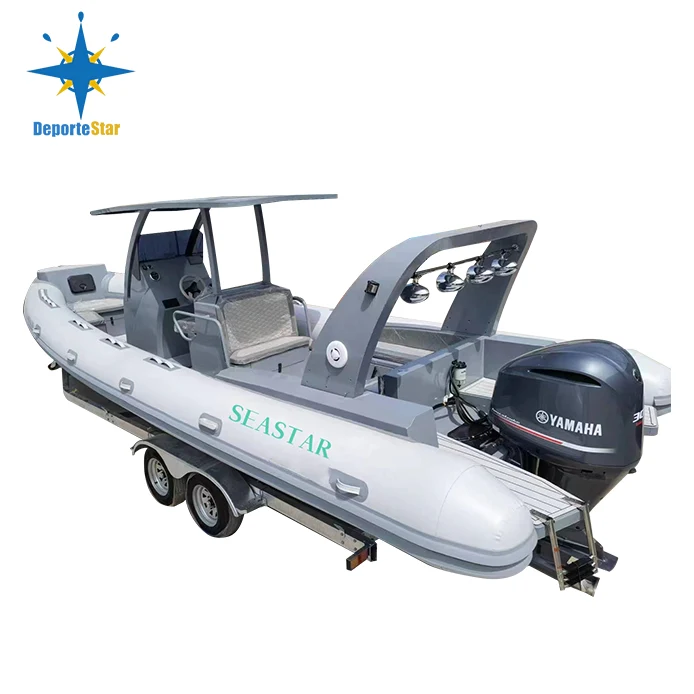
Understanding the Three Weight Categories for Towing
Trailer weight is not a single number. To accurately answer “how much,” we must separate three distinct figures:
| Weight Category | Definition | Typical Range (lbs) |
|---|---|---|
| Dry Boat Weight | Hull + tubes + deck + fixed fixtures (no fuel, water, gear) | 2,800 – 3,500 |
| Wet Weight (as towed) | Dry weight + full fuel (150–200 gal) + water + batteries + safety gear | 4,200 – 5,100 |
| Trailer Weight | Aluminum or galvanized tandem-axle trailer with surge brakes | 1,100 – 1,500 |
| Gross Trailer Weight (GTW) | Wet boat + trailer + optional gear (dive compressor, extra spare) | 5,300 – 6,600 |
Critical takeaway: The minimum Gross Trailer Weight for a 28ft Salt Water Inflatable RIB Boat typically falls between 5,300 and 6,600 lbs (2,400–3,000 kg). However, a fully rigged DeporteStar 28-footer with twin 200HP outboards, a T-top, and full electronics often exceeds 7,000 lbs—which pushes into Class 4 trailer territory.
Breaking Down the Dry Hull and Tube Contribution
The hypalon/PVC tubes add significant mass. A 28ft Salt Water Inflatable RIB Boat has a deep-V fiberglass hull (approx. 1,800–2,200 lbs) plus five air chambers with reinforced fabric (approx. 600–800 lbs). The console, bench seats, and steering system add another 400 lbs. DeporteStar uses high-density foam-filled collars for improved buoyancy, which adds roughly 80 lbs compared to standard air-only tubes—but this trade-off drastically improves puncture resistance in rocky launch zones.
Fuel and Fluids: The Hidden 800–1,000 lbs
Most owners underestimate fuel weight. A 28ft RIB typically carries 150–200 gallons of gasoline. At 6.3 lbs per gallon, that is 945–1,260 lbs of fuel alone. Add:
-
20 gallons fresh water (for deck shower) → 160 lbs
-
Two group-31 AGM batteries → 130 lbs
-
Anchor, chain, and 300 ft of rode → 120 lbs
-
Safety gear (life raft, EPIRB, tool kit) → 80 lbs
This brings the "as-towed" wet weight to roughly 4,800 lbs before the trailer is even attached.
Trailer Selection: Aluminum vs. Galvanized Steel
| Trailer Material | Weight (tandem axle) | Saltwater Corrosion Resistance | Cost |
|---|---|---|---|
| Aluminum (I-beam) | 1,100 – 1,250 lbs | Excellent (preferred for salt) | Higher |
| Galvanized steel | 1,350 – 1,550 lbs | Good (requires annual rinsing) | Lower |
For a 28ft Salt Water Inflatable RIB Boat, DeporteStar strongly recommends aluminum trailers with disc brakes (not drum) because saltwater intrusion destroys drum internals quickly. A galvanized trailer adds 200+ lbs, which may push you over your tow vehicle’s rated capacity.
Tow Vehicle Requirements by GTW Class
Based on the 6,000–7,000 lb GTW range, your tow vehicle must have:
-
Minimum curb weight: 5,500 lbs (to control sway)
-
Engine: V8 or turbo-diesel with 400+ lb-ft torque
-
Hitch class: Class IV (2-inch receiver, 10,000 lb capacity)
-
Brake controller: Integrated electric-over-hydraulic or surge (check state laws—many require brakes on both axles above 3,000 lbs)
Example: A Ford F-150 with the 3.5L EcoBoost (max tow 11,300 lbs) works well, but a Jeep Gladiator (7,650 lbs max) would be dangerously marginal for a fully loaded DeporteStar 28ft model.
Legal and Safety Margins (The 80% Rule)
Professional marine towing guides recommend never exceeding 80% of your vehicle’s stated maximum tow capacity. For a 6,600 lb GTW, that means your vehicle should be rated for at least 8,250 lbs. This margin accounts for:
-
Mountain grades and high-altitude derating
-
Crosswinds on coastal highways
-
Emergency braking distance (adds 30–40 ft at 60 mph)
A 28ft Salt Water Inflatable RIB Boat has a large frontal area (over 8 ft beam), so wind resistance acts like a sail—this multiplies the effective towing load by roughly 1.3x at highway speeds.
28ft Salt Water Inflatable RIB Boat – FAQ
Q: Can I tow a 28ft Salt Water Inflatable RIB Boat with a half-ton pickup truck like a Ram 1500?
A: Yes, but only if the truck is properly equipped with the max tow package (class IV hitch, integrated brake controller, and heavy-duty cooling). The Ram 1500 with the 5.7L Hemi has a max tow of 8,210–8,670 lbs depending on axle ratio—this places your 6,600 lb GTW at roughly 76–80% of capacity, which is acceptable. However, you must use a weight-distributing hitch to level the rear suspension, and you should always tow with an empty water tank to save 160 lbs. For frequent towing (weekly), DeporteStar advises upgrading to a 3/4-ton truck for longer component life.
Q: Does the trailer weight include the outboard engines, or are they calculated separately?
A: The outboards are always included in the wet boat weight—not the trailer weight. For a twin-engine setup (e.g., two 200HP four-strokes), the engines contribute roughly 1,100–1,200 lbs combined. When you see a manufacturer’s "dry weight" for a 28ft Salt Water Inflatable RIB Boat, confirm whether it includes engines; many brands (including DeporteStar) publish dry weight without engines to show a lower number. Always add engine weight, fuel, and gear to your GTW calculation. A common mistake is using dry hull weight only, which understates your actual towed mass by over 1,500 lbs—leading to unsafe braking and potential trailer frame fatigue.
Q: What type of trailer brakes are legally required for a 28ft Salt Water Inflatable RIB Boat in the US?
A: Federal FMVSS 121 requires that any trailer with a GTW over 3,000 lbs must have brakes on all axles. For your 6,600 lb RIB, this means a tandem-axle trailer with surge brakes (hydraulic, actuated by the tow vehicle’s deceleration) or electric-over-hydraulic (EoH) brakes. EoH is superior for saltwater use because it provides proportional braking independent of tongue weight shifts—critical when launching on steep ramps. DeporteStar equips its factory-recommended trailers with EoH and stainless-steel calipers. Additionally, 36 states require a breakaway system with a battery that automatically applies the trailer brakes if it detaches from the hitch—this is non-negotiable for any 28ft class vessel.
Final Checklist Before Every Tow
-
□
Verify tire pressure (trailer tires at max cold PSI—usually 65–80 psi)
-
□
Check tongue weight (should be 10–15% of GTW → ~660–990 lbs)
-
□
Inspect safety chains (crossed under the tongue)
-
□
Test all brake and turn signals with a 7-pin connector tester
-
□
Confirm the trailer’s GVWR plate exceeds your loaded boat weight
Why Accurate Weight Matters for Your DeporteStar Investment
Overloading a trailer voids warranties, accelerates bearing wear, and increases stopping distances by over 40% on wet roads. DeporteStar designs its 28ft RIBs with a detailed towing placard placed inside the console—always reference that specific hull ID number, because optional features (like a dive door or additional fuel tank) change the base weight by ±200 lbs. When in doubt, visit a public scale with your fully loaded rig and weigh each axle separately.
Ready to spec the right trailer for your 28ft Salt Water Inflatable RIB Boat? The DeporteStar team provides free towing calculations with every new hull—including custom aluminum trailer builds matched to your exact engine configuration. Contact our marine specialists today for a personalized weight audit and hitch recommendation. We also offer nationwide delivery with professional tow-vehicle matching. Reach out now to secure your towing package and hit the water with total peace of mind.