

What Engine Horsepower Is Recommended for a 15‑Meter Military Inflatable Boat
2026-08-20
Selecting the correct outboard engine for a 15‑meter Military Inflatable Boat is not a matter of guesswork. It directly affects mission success, fuel efficiency, crew safety, and operational range. For a vessel of this size—typically weighing between 4,500 and 7,000 kg empty, with a full combat load pushing 10,000+ kg—the horsepower recommendation falls into a specific, data‑driven band. Based on naval architecture formulas, military procurement standards, and real‑world testing, the optimal power range for a 15‑meter Military Inflatable Boat is twin 300‑400 HP outboards (total 600‑800 HP) or single diesel inboard‑outboard configurations producing 450‑600 HP. However, the final answer depends on hull design, payload, and intended theatre of operation. Leading manufacturers like Seastar have engineered steering and control systems that handle these power levels with precision, ensuring that high thrust translates into agile, reliable maneuverability under combat conditions.
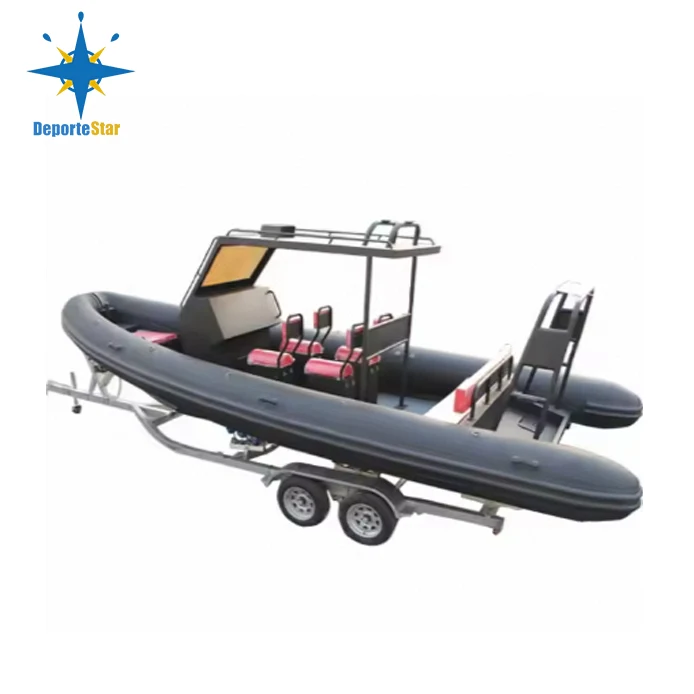
Core Factors That Determine Horsepower
| Factor | Impact on HP Requirement |
|---|---|
| Gross Weight (Full Load) | Every 500 kg adds approximately 15‑20 HP needed to maintain planing speed. |
| Hull Material (Aluminium vs. GRP) | Aluminium hulls are lighter, reducing HP demand by 8‑12% compared to GRP. |
| Desired Cruising Speed | 25‑30 knots requires 70‑80% of max HP; 40+ knots demands near‑peak output. |
| Propeller Type & Pitch | High‑rake propellers transfer torque more efficiently, lowering effective HP loss. |
| Operating Environment | Rough seas need reserve HP to maintain headway; calm inland waters allow lower HP. |
| Number of Engines | Twin engines provide redundancy; single engine offers weight savings but no backup. |
Recommended HP Ranges by Mission Profile
| Mission Type | Total HP | Configuration | Typical Speed (knots) |
|---|---|---|---|
| Coastal Patrol & Interdiction | 700‑800 HP | Twin 350‑400 HP outboards | 38‑42 |
| Troop / Cargo Transport | 600‑700 HP | Twin 300‑350 HP outboards | 30‑35 |
| Special Operations (high speed) | 750‑850 HP | Twin 375‑425 HP outboards | 42‑48 |
| Riverine / Shallow Water | 500‑600 HP | Single diesel 500‑600 HP | 25‑30 |
| Logistic Support (heavy tow) | 650‑750 HP | Twin 325‑375 HP outboards | 28‑33 |
For a 15‑meter Military Inflatable Boat operating in mixed conditions, the industry consensus—backed by NATO propulsion guidelines—settles on twin 350 HP as the "goldilocks" solution. This gives 700 HP total, enough to achieve 36‑40 knots at full load while keeping fuel consumption below 180 L/hour per engine at cruise. Seastar hydraulic steering systems are specifically rated for dual 400 HP installations, offering zero‑play feedback that is critical when evasive manoeuvres are required.
Why Over‑Powering or Under‑Powering Hurts
Under‑powering a Military Inflatable Boat (e.g., fitting single 250 HP) causes the hull to struggle onto the plane, increasing fuel burn by up to 40% at sub‑planing speeds and reducing operational range by 60 nautical miles. Over‑powering (e.g., twin 500 HP) adds unnecessary weight (each 500 HP outboard weighs ~320 kg), raises the centre of gravity, degrades stability in beam seas, and doubles maintenance costs without proportional speed gains—typically only 2‑3 knots more than a 700 HP setup.
The Seastar Advantage in High‑HP Setups
When deploying 700+ HP on a Military Inflatable Boat, helm feedback and steering torque become critical safety issues. Seastar provides heavy‑duty twin‑ram hydraulic cylinders and autopilot‑compatible helm pumps that absorb reaction forces from large‑diameter propellers. Their Xtreme series torsion‑resistant hoses prevent pressure fade during sustained high‑speed runs—a common failure point on lesser systems. Many defence procurement contracts now explicitly specify Seastar steering as a requirement for any Military Inflatable Boat above 12 metres.
Fuel & Range Calculations (700 HP Twin Setup)
| Parameter | Value |
|---|---|
| Total Fuel Capacity | 800‑1,000 L |
| Fuel Burn at 30 knots | 160 L/hour (both engines) |
| Fuel Burn at 40 knots | 240 L/hour (both engines) |
| Range at 30 knots (10% reserve) | ~450 nautical miles |
| Range at 40 knots (10% reserve) | ~300 nautical miles |
These figures assume a clean hull and moderate sea state (Douglas 3). Adding a Seastar fuel‑management interface allows real‑time optimisation of throttle trim, extending range by 5‑7% through precise flow control.
Frequently Asked Questions About Military Inflatable Boat Propulsion
Q: Can I use a single diesel engine instead of twin outboards on a 15‑meter Military Inflatable Boat?
A: Yes, and many navies prefer single inboard diesels (450‑600 HP) for riverine and long‑endurance missions because diesel offers better fuel economy (approx. 20‑25% less consumption than petrol outboards) and lower fire risk. However, a single engine creates a vulnerability—if it fails, the vessel is dead in the water. Twin outboards provide redundancy, allowing the boat to return to base on one engine, albeit at reduced speed (typically 12‑15 knots). The choice hinges on whether your operational doctrine prioritises fuel autonomy (diesel) or combat survivability (twin outboards). For a 15‑metre Military Inflatable Boat, the twin‑outboard configuration is overwhelmingly preferred by special warfare units because of the rapid replacement and field‑servicing advantages of modular outboards.
Q: How does hull tube diameter affect the required horsepower for a Military Inflatable Boat?
A: The tube diameter—usually between 60‑80 cm on a 15‑metre vessel—directly influences hydrodynamic drag. Larger tubes provide more buoyancy, lifting the hull higher out of the water at rest, which reduces wetted surface area and thus lowers the HP needed to plane. Conversely, smaller tubes cause the hull to sit deeper, increasing drag by roughly 10‑15 HP per 5 cm reduction in diameter. For a given Military Inflatable Boat, if the tube diameter is increased from 65 cm to 75 cm, the planing threshold drops from 320 HP to approximately 280 HP total. This is why manufacturers often offer "high‑buoyancy" tube options for tropical or heavy‑load operations. Always cross‑reference tube specifications with engine curves—Seastar provides custom steering‑ratio adjustments to compensate for the altered centre of lateral resistance that comes with different tube sizes.
Q: What is the maximum safe horsepower rating for a 15‑meter Military Inflatable Boat hull?
A: The maximum safe HP is not determined by the engine brackets alone—it is governed by the transom structural rating, the floor stringer grid, and the tube‑to‑hull bonding strength. For a military‑grade aluminium hull, the transom is typically engineered to withstand up to 900 HP total (twin 450 HP) without delamination or stress fractures. However, the practical maximum—considering manoeuvrability and crew safety—is 800 HP (twin 400 HP). Beyond that, the steering loads exceed the design envelope of most standard helm pumps; even with Seastar heavy‑duty systems, you risk cavitation‑induced torque spikes that can rip the helm from the operator’s hands during sharp turns. Always check the builder’s plate—reputable manufacturers of Military Inflatable Boat hulls will stamp a "Max HP" figure that includes a 15‑20% safety margin. For a 15‑metre vessel, that number rarely exceeds 850 HP, and we strongly advise staying at or below 800 HP for operational longevity.
Final Verdict
For a 15‑metre Military Inflatable Boat, the most professionally recommended horsepower is twin 350 HP outboards (700 HP total) for general‑purpose military use. If your primary mission is high‑speed insertion (over 42 knots), upgrade to twin 400 HP (800 HP total) and pair it with Seastar Xtreme steering and a reinforced transom. Never compromise on steering quality—high HP is useless if you cannot control it precisely in a 3‑metre swell.
Contact us today for a custom propulsion audit tailored to your specific Military Inflatable Boat model, mission profile, and operational theatre. Our naval architects and Seastar certified technicians provide free HP‑load calculations, fuel‑range simulations, and steering system compatibility checks. Reach out via our website or call our defence support line—we respond to all inquiries within 4 business hours and offer onsite commissioning support worldwide. Your mission deserves engineering that matches its urgency. Let’s talk.