

What Makes a Patrol RIB Boat Ideal for Law Enforcement Operations?
2026-09-11
1. Why Does the RIB Hull Design Provide Superior Stability and Boarding Safety?
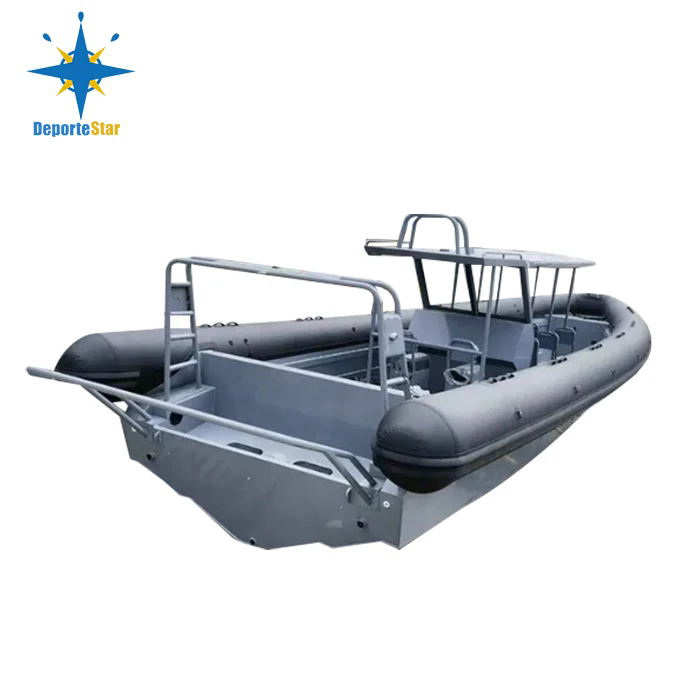
The defining feature of a Patrol RIB Boat is the combination of a rigid hull and inflatable buoyancy tubes. The rigid hull provides the structural strength, the planing surface, and the mounting points for the engine and console. The inflatable tubes provide secondary buoyancy, impact absorption, and a stable platform for boarding. When a suspect vessel is intercepted, the boarding team must be able to step from the patrol boat onto the other vessel safely. The inflatable tubes absorb the impact and provide a forgiving surface that prevents injuries. In our factory, we manufacture Patrol RIB Boat units with tube diameters of 450 to 600 mm, which provide sufficient buoyancy and standoff distance. The tubes are divided into multiple air chambers so that a puncture in one chamber does not compromise the entire boat.
Stability comparison: A Patrol RIB Boat with a 21-degree deadrise hull and 500 mm tubes provides a static stability that is 30 to 40 percent higher than a comparable hard-hull boat. This stability is critical for boarding operations in rough seas.
Qingdao Seastar Sport Equipment Co.,Ltd. manufactures Patrol RIB Boat units with hypalon or PVC tubes, depending on the operational environment. Hypalon is preferred for tropical and high-UV environments because it resists UV degradation and abrasion better than PVC. We also offer a foam-filled tube option for agencies that require unsinkable buoyancy.
2. How Does the Patrol RIB Boat Handle High-Speed Interception and Maneuvering?
Interception missions require a vessel that can accelerate quickly, reach a high top speed, and maneuver aggressively. The deep-V hull of a Patrol RIB Boat is designed to cut through waves and provide a smooth ride at high speed. The deadrise angle—the angle between the hull bottom and the horizontal—determines the trade-off between speed and comfort. A deeper deadrise (22 to 24 degrees) provides a softer ride in rough water but requires more power. A shallower deadrise (18 to 20 degrees) provides higher speed in calm water but a rougher ride in waves. The table below shows the performance characteristics of different deadrise angles for a 7.5-meter Patrol RIB Boat.
| Deadrise angle | Top speed (knots, twin 150 hp) | Fuel consumption at cruise (L/h) | Ride comfort in 1m waves | Recommended mission profile |
| 18 degrees | 48 – 52 | 38 – 42 | Moderate | Calm water, short range interdiction |
| 20 degrees | 44 – 48 | 42 – 46 | Good | Coastal patrol, moderate sea states |
| 22 degrees | 40 – 44 | 45 – 50 | Very good | Rough water, long range patrol |
| 24 degrees | 36 – 40 | 48 – 54 | Excellent | Search and rescue, heavy weather |
The choice of deadrise angle should be based on the typical sea state in the operating area. For agencies operating in protected harbors and rivers, a shallower deadrise is sufficient. For agencies operating in open coastal waters with frequent 1 to 2 meter waves, a deeper deadrise is recommended. Our factory works with each customer to determine the optimal hull design based on their operating environment.
3. What Are the Key Configuration Options for Law Enforcement Patrol RIB Boats?
A Patrol RIB Boat can be configured for different mission profiles. The most common configurations are the center console, the side console, and the cabin version. The center console provides the best weight distribution and 360-degree visibility, which is ideal for intercept and boarding operations. The side console provides more deck space for equipment and personnel, which is preferred for search and rescue. The cabin version provides protection from the elements for the crew, which is important for extended patrols in cold or wet climates. The table below compares the features of these configurations.
| Configuration | Deck space (m²) | Visibility | Weight distribution | Typical mission |
| Center console | 4.5 – 5.5 | 360 degrees | Optimal | Interdiction, boarding |
| Side console | 5.5 – 6.5 | Good (limited on one side) | Offset to one side | Search and rescue, diving |
| Cabin | 3.5 – 4.5 (plus cabin) | Moderate (windows) | Balanced | Extended patrol, cold climate |
In addition to the console configuration, a Patrol RIB Boat can be equipped with a range of law enforcement specific features, including a boarding platform, a towing bitt, a self-righting system, and a weapons mount. Qingdao Seastar Sport Equipment Co.,Ltd. manufactures all of these configurations and can customize the layout to meet specific agency requirements.
4. What Are the Lifecycle Cost Considerations for a Patrol RIB Boat?
The purchase price of a Patrol RIB Boat is only the beginning of the cost of ownership. The lifecycle cost includes fuel, maintenance, tube replacement, and engine overhaul. The table below shows the typical lifecycle cost for a 7.5-meter Patrol RIB Boat over 10 years.
| Cost category | Year 1 – 3 | Year 4 – 7 | Year 8 – 10 |
| Fuel (500 hours/year) | $12,000 – $15,000 | $14,000 – $18,000 | $16,000 – $20,000 |
| Routine maintenance | $2,000 – $3,000 | $3,000 – $4,500 | $4,000 – $6,000 |
| Tube replacement (hypalon) | — | — | $8,000 – $12,000 |
| Engine overhaul or replacement | — | — | $15,000 – $25,000 |
| Total 10-year lifecycle cost | $120,000 – $180,000 (excluding initial purchase) | ||
The choice of tube material and engine brand has a significant impact on the lifecycle cost. Hypalon tubes last 8 to 12 years, while PVC tubes last 5 to 7 years. Four-stroke engines have lower fuel consumption and longer overhaul intervals than two-stroke engines. Our factory can provide a detailed lifecycle cost analysis based on the specific configuration and operating profile.
Frequently Asked Questions About Patrol RIB Boats for Law Enforcement
Summary for Law Enforcement Procurement Officers
A Patrol RIB Boat is the ideal platform for maritime law enforcement because it combines high speed, superior stability, and mission flexibility in a single package. The rigid hull provides the performance, the inflatable tubes provide the safety, and the modular design provides the adaptability. When evaluating a procurement, consider the operating environment, the mission profile, and the lifecycle cost—not just the purchase price. The right configuration will serve your agency for a decade or more. Qingdao Seastar Sport Equipment Co.,Ltd. has been manufacturing Patrol RIB Boat units for law enforcement agencies for over 15 years.
Qingdao Seastar Sport Equipment Co.,Ltd. manufactures Patrol RIB Boat units in lengths from 5.5 to 12 meters, with custom configurations for law enforcement, search and rescue, and military applications. We provide full technical documentation, sea trial reports, and training for your crew.